Completion, Agency, and the Quiet Work of Seeing Clearly: An Insight into the Hasidic World
- The Panda
- Feb 15
- 4 min read
by The Panda
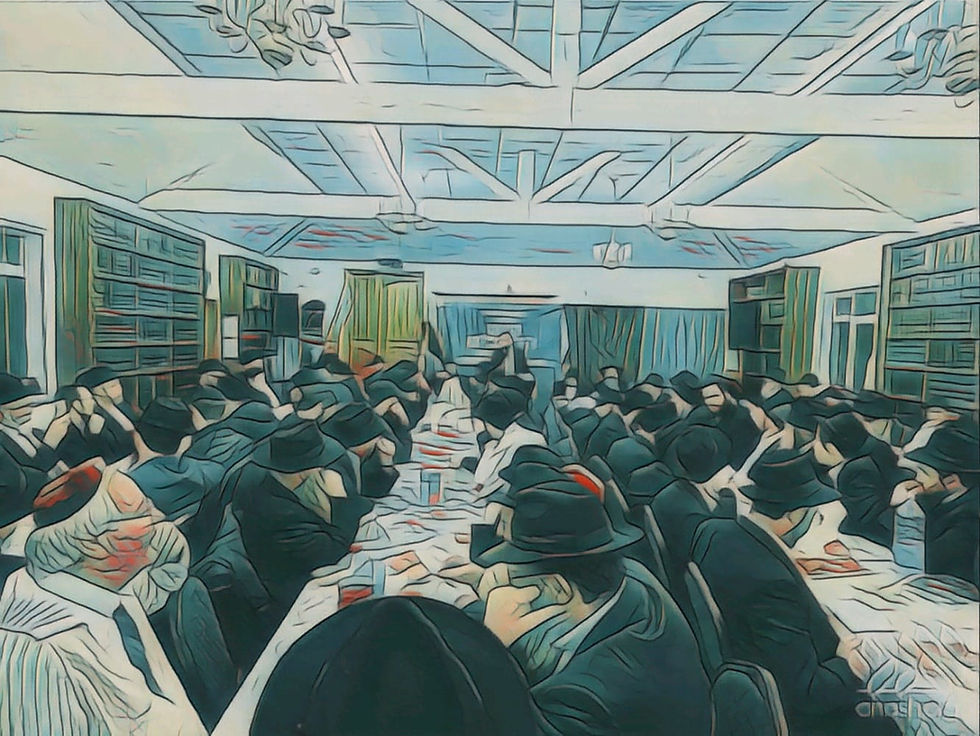
Recently, I attended a large learning celebration in North London. More than 150 people gathered to mark the completion of a cycle of study of the writings of Maimonides — a medieval Jewish thinker who attempted to organise law, ethics, and daily life into a coherent system. The event was joyful and communal. But what stayed with me was not the music. It was a repeated theme from the speakers: completion matters.
One speaker reflected on balance — that serious study should not detach a person from the world of work, but discipline it. Another spoke about strength — not dramatic heroism, but steadiness over time. A third observed that character is revealed not when one is watched, but in what one does when no one is looking. Beneath all of it was a quiet insistence: if you begin something, you should see it through.
For many in the room, this was a celebration of continuity. For me, it arrived during the thirty-day mourning period following my mother’s death — a time traditionally devoted to reflection. Completion, in that moment, did not feel triumphant. It felt complicated.
Because sometimes the difficulty is not beginning. It is being permitted to act with full agency.
Agency, put simply, is the ability to stand directly within one’s own decisions — to speak, act, and be held responsible without mediation. Most ethical systems assume its presence. Many legal systems depend on it. But in real life, agency can be constrained not only by force, but by structure: by relationships, expectations, and well-intentioned forms of protection.
Jewish law contains a striking idea that helped me make sense of this. In the biblical sabbatical year, debts are cancelled and land is left to rest. At first glance, this sounds like a spiritual reset. But on closer reading, it is more exacting. Release applies only to obligations that were properly formed in the first place. A debt must have been validly created before it can be cancelled. Freedom is not an escape from responsibility; it is the final stage of it.
That distinction matters far beyond agriculture.
Over the past fifteen years, much of my professional and communal life unfolded through mediation — often through my mother. This was not sinister. It was familial, protective, and rooted in care. In many religious traditions, honouring one’s parents is not symbolic; it carries real moral weight. It shapes how disagreement may be expressed and how independence is asserted.
But mediation, even when motivated by love, can narrow the conditions for agency. When engagement is consistently routed through another person, decisions may be discussed around someone rather than with them. Silence can appear voluntary even when it carries relational cost. Over time, it becomes difficult to tell whether a project has stalled because of lack of will — or because the conditions required for direct agency never fully materialised.
This is not an accusation. It is a structural observation.
Communities often believe they are protecting. Institutions believe they are managing risk. Yet protection can unintentionally displace voice. Management can quietly become mediation. And mediation, when sustained, can prevent a person from standing unambiguously within their own undertaking.
One of the speakers that evening, Rabbi Brendan Stern, Associate Minister of Hendon United Synagogue, offered language that proved unexpectedly clarifying. Reflecting on a classical Jewish idea known as bittul ayin, he explained that strength is not found in asserting oneself at every moment, but in the capacity to step back from the self just enough to see clearly. Bittul ayin, as he described it, is not self-negation, but humility — the discipline of quieting one’s own urgency so that wisdom can emerge. In more secular terms, it is the difference between reacting and reflecting.
It was only through that kind of humility that I was able to understand what had actually been at stake. This was not a story about fault or grievance, but about agency: about the difference between acting and being permitted to act, between responsibility carried directly and responsibility mediated through others.
Completion presumes formation. It assumes that a person began freely, clearly, and with the capacity to own what they undertook. Where agency was structurally constrained, the obligation to complete does not disappear — but it cannot be assessed in the usual way. One cannot demand closure where something was never allowed to stand fully on its own.
Work, in this sense, becomes more than productivity. It becomes the place where agency is rebuilt. Classical Jewish sources insist that labour is not merely a means of survival, but a condition of dignity. Even traditions that emphasise divine providence reject withdrawal from responsibility. Human beings are meant to act — but to act as agents, not as proxies.
For me, the past fifteen years involved sustained effort alongside study and employment, often under conditions where direct agency was complicated by relational and communal constraints. The result was not abandonment. It was endurance. What was missing was not commitment, but clarity of standing.
Mourning has a way of clarifying this. When a parent dies, the adult child stands differently in the world. Honour does not disappear, but mediation does. Responsibility becomes more direct. Agency becomes unavoidable.
The celebration I attended marked the end of a cycle and the beginning of another. That is how most lives unfold — not in clean breaks, but in chapters. Yet chapters are meaningful only when they are written by the person whose life it is.
Completion, I have come to believe, is not merely about finishing what one started. It is about ensuring that what was started was truly one’s own. And that insight did not come from anger or demand, but from bittul ayin — the humility to step back far enough to see clearly what responsibility really requires.
Strength, as those speakers suggested, is not spectacle. It is the patience to rebuild agency — and the courage to complete honestly, once that agency is real.


Comments