The Hasidic Panda – Part Three: The File Did Not Close
Updated: Apr 24
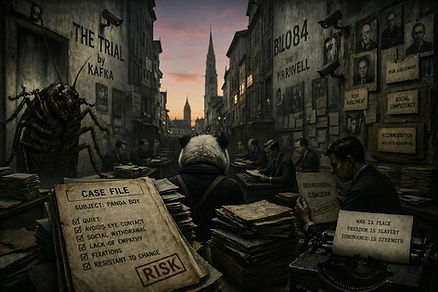
by The Panda
The file did not begin as a file.
It began as a note.
A small one—almost careful.
Written, it seemed, out of concern.
The Panda Boy had not seen it written.
But he felt, somehow, that something had been placed somewhere that would remain.
It did.
And then something else was added.
Not immediately.
But not long after.
A second paper does not feel like an addition.
It feels like a continuation.
By the third, it begins to resemble something that has always been there.
He was asked to return.
Not to the same room.
The room was similar, but not the same.
This was explained to him, though not clearly.
The explanation was not meant for him.
There were more chairs this time.
Not all of them were used.
He wondered, briefly, whether they had been filled before he arrived.
They asked him questions.
Not new ones.
But they sounded different.
Not in tone. In placement.
Each question seemed to come from somewhere that had already been written.
He answered.
He tried to answer as he had before.
But something had shifted.
He could not tell if he was being asked what had happened or whether he was being asked to confirm what had already been understood.
When he spoke, they wrote.

Not quickly.
Carefully.
As if precision mattered.
He noticed that sometimes they would pause—not when he paused, but when he said something that seemed to require adjustment.
The writing would slow then.
Or stop.
And then continue, slightly differently.
He began to notice the pauses.
He tried to avoid them.
He adjusted how he spoke—not to be clearer, but to leave less room.
It did not help.
The pauses came anyway.
They seemed to come from elsewhere.
At one point, he did not answer immediately.
It was not a refusal.
It was not resistance.
He was thinking.
The silence was brief.
But it was written.
He knew this without seeing it.
The silence had weight.
More, perhaps, than the words.
They asked him again.
The same question.
But this time it included something.
A word that had not been there before.
He recognised the shape of it.
Not the meaning.
The word seemed to come from the file.
He realised, then—not fully, but enough—
that he was no longer answering questions.
He was responding to something that was being built.
Each answer did not stand alone.
It attached.
It settled.
It aligned with what had already been said.
There were more rooms.
He was not always told why.
Each room contained something slightly different.
A tone.
A posture.
A way of looking at him that suggested that something had already been shared.
He was introduced, once, by something that was not his name.
It was not incorrect.
But it was not him.
No one asked if he was well.
They asked if he understood.
No one asked what he needed.
They asked if he agreed.
The agreement seemed important.
Not for him.
For the file.
He tried, once, to explain.
Not defensively.
Not urgently.
Just to place something where nothing had yet been written.
They listened.
They nodded.
It was written.
But when it appeared again, later, it had changed shape.
It now belonged to something else.
He began to understand that there was no correct way to appear.
Only ways that could be used.
If he spoke, it was useful.
If he paused, it was useful.
If he tried to clarify, this too was useful.
Nothing was neutral.
Everything could be placed.
The file grew.
It did not feel larger.
It felt heavier.
Not in size.
In certainty.
Each page made the next one easier to write.
There were moments—brief, and difficult to hold—when he felt that something might still be asked differently.
That someone might look at him, not through what had been written, but before it.
These moments passed.
Not abruptly.
But completely.
Concern was expressed.
Often.
It appeared in the language.
It appeared in the tone.
It appeared, most clearly, in the way things were recorded.
But nothing followed it.

Concern did not move.
It settled into the file.
He began, slowly, to anticipate.
Not the questions.
The interpretations.
He adjusted accordingly.
Not to be understood.
But to leave less behind.
At some point—and he could not say when—
He stopped trying to separate what he had said from what had been written.
They no longer felt distinct.
He was shown something once.
Not the whole file.
Just a part.
It was enough.
He recognised himself.
Not in what was written.
But in the way it no longer required him.
It was not that they believed he was something.
It was that they no longer needed him to be anything else.
The file did not close.
It did not need to.
It had already begun to speak on its own.


Comments