Chapter 5: The Panda and the Mirror

by Aloysius, the Panda
The strange thing was never that the Panda was different.
The strange thing was that everybody else became so busy explaining the Panda that nobody stopped to ask whether they were looking into a mirror.
By now the files were thick.
Assessments.
Reports.
Meetings.
Concerns.
Observations.
Opinions.
Narratives.
A thousand fragments of paper describing a creature that appeared nowhere except within the paperwork itself.
The Panda remained stubbornly present in reality.
The Panda still laughed at inappropriate moments.
Still asked inconvenient questions.
Still believed that words should mean what they say.
Still believed that evidence mattered.
Still believed that people should be judged by what they did rather than by what others feared they might become.
That was perhaps the greatest offence.
Not because it was criminal.
Not because it was dangerous.
But because it exposed something uncomfortable.
The more the institutions spoke about risk, the less they appeared able to tolerate uncertainty.
The more they spoke about safeguarding, the less they seemed capable of hearing disclosure.
The more they spoke about inclusion, the less space there appeared to be for anyone who did not fit the approved narrative.
And so a curious inversion occurred.
The Panda became a screen.
Every fear could be projected onto it.
Every anxiety could be transferred onto it.
Every unresolved social conflict could be placed neatly upon its back.
Jew.
Autistic.
Religious.
Male.
Different.
The labels accumulated like stickers on old luggage.
Each observer saw a different Panda.
The activist saw oppression.
The bureaucrat saw risk.
The clinician saw pathology.
The politician saw demographics.
The community saw embarrassment.
The algorithm saw data.
The Panda remained a Panda.
Nobody seemed interested in that fact.
What emerged was not a conspiracy.
Conspiracies require coordination.
This was something far older and more dangerous.
An ecosystem.
A collection of incentives operating independently yet arriving at the same destination.
No single individual needed to act maliciously.
No single institution needed to intend harm.
Each participant merely responded to the assumptions created by the participant before them.
A note became a concern.
A concern became an assessment.
An assessment became a profile.
A profile became a risk indicator.
A risk indicator became a justification.
The justification became reality.
By the end, nobody could remember where the story began.
The file was now citing itself.
The evidence was the existence of previous evidence.
The concern was the existence of previous concern.
The justification was the existence of previous justification.
And all the while the Panda stood in the centre asking a question so simple that it became almost impossible to answer.
"Where is the original fact?"
Silence followed.
Not because there was no answer.
But because finding the answer would require dismantling too much.
Institutions survive mistakes.
They struggle to survive admissions.
Communities survive disagreements.
They struggle to survive reflections.
Individuals survive uncertainty.
They struggle to survive accountability.
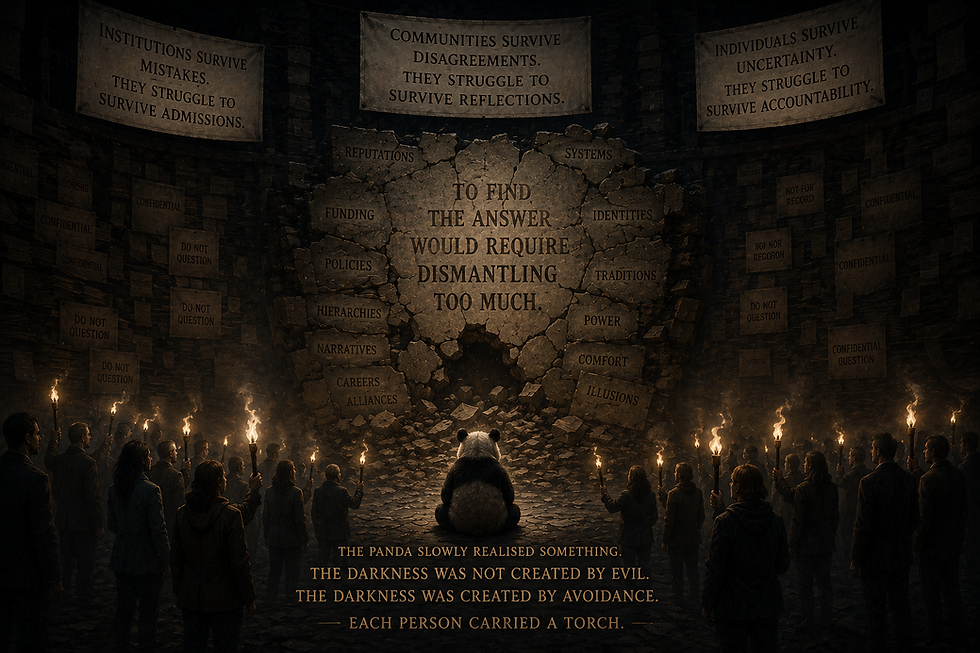
The Panda slowly realised something.
The darkness was not created by evil.
The darkness was created by avoidance.
Each person carried a torch.
Nobody wished to shine it in the direction that mattered.
Because somewhere beneath the paperwork, beneath the narratives, beneath the assessments and interventions, lay an uncomfortable possibility.
What if the Panda was not the problem?
What if the Panda was merely the witness?
A witness to how quickly societies construct explanations for difference.
A witness to how easily safeguarding becomes control when fear replaces curiosity.
A witness to how narratives become more valuable than truth.
A witness to how people begin seeing categories instead of human beings.
The Panda understood then why disclosure felt impossible.
Not because nobody could hear.
But because hearing would require seeing.
And seeing would require responsibility.
The mirror stood before them all.
Most preferred the file.
The file was easier.
The mirror was honest.
And so the Panda continued forward.
Not because the Panda believed the road was safe.
Not because justice was guaranteed.
Not because vindication was certain.
But because facts have a stubborn quality.
They remain.
Long after narratives collapse.
Long after institutions change.
Long after reports gather dust.
Long after the people who wrote them have forgotten.
Facts remain.
The Panda remained too.
And somewhere beyond the forest, beyond the noise, beyond the endless attempts to explain him away, a library waited beside the sea.
A place where evidence would matter.
A place where disclosure would be heard.
A place where the mirror would no longer be feared.
The Panda kept walking toward it.


Comments