THE YELLOW DOOR

A testimony by Aloysius, the Panda by The Rev Rabbi Eliyahu Leib Esq

I.
I should tell you what I am before I tell you what I saw, because the two things are the same difficulty.
I am, at present, a panda. Stuffed, worn at one ear, kept on a shelf in a house in Hackney. That is my vessel. It is not my age.
I do not remember becoming what I am in any way that would satisfy a court. I have no first memory, only a kind of pressure, the way a bruise remembers a blow it cannot describe. What I have instead of memory is recurrence. A cart. A gate closing at dusk. A piece of yellow cloth, sewn by someone else's hand onto someone else's coat, not because they chose it but because a council somewhere had decided that a person could be made visible against their will, for the comfort of everyone who was not required to wear it.
I do not know which century that was. I only know that it was early, and that it did not end.
I have been carried since — through more towns and more expulsions than I can order into a single line — inside whatever body happened to be at hand: wood once, I think. Cloth, more than once. Now stuffing and glass eyes and a seam coming loose at the shoulder. The vessel changes. What is carried inside it does not resolve so easily. It only travels. It also, I have learned, does not always survive intact — a lineage can outlast an empire and still come apart in a kitchen, on an ordinary evening, for reasons no expulsion ever taught me how to carry.
This is the only claim I make for myself: not that I understood Miriam, but that something in me recognised her before I had reasons to.

II.
She had been told, as a child, that yellow was a colour of welcome — a colour that said you may come here, you are safe — and something in me went very still the first time I heard that said aloud in her house, because I have carried yellow a long way, and it has not often meant that.
Her parents had left Algeria, in the manner of all such departures — not chosen so much as arrived at, the way a person does not choose to jump from a burning building so much as discover they have already jumped. Being Jewish there had gone, gradually and then all at once, from an ordinary fact to a dangerous one. First the whispers. Then the warnings. Then the boat.
They settled in Paris, in a flat that smelled faintly of a country none of them would see again, and it was there, two years later, that Miriam was born — into a household of careful, exhausted gratitude, the particular kind that follows people who have already used up one home and are trying very hard not to need a third.
She grew up between two absences: the country that had made her family leave, and the country they had landed in but never quite finished entering. At nineteen she met a boy her own age, English, in Paris for reasons neither of them could ever afterward agree on. He talked about the village he came from, and about fields that turned an entire valley the colour of lavender every July, and something old and very specific in her — a hunger for a place that would never once ask her to explain herself — fastened onto him, and onto the fields, and onto the word itself, long before she had seen either.
She called it, privately, her lavender marriage. Not the tired, borrowed kind of that phrase, made to hide something. The other kind — the kind you enter because a word got into you young and never entirely let go. She married him within the year and crossed the water a second time, this time toward a country rather than away from one, carrying a suitcase, a photograph, and her grandmother's prayer book, exactly as her own parents once had.
She arrived in Britain believing, for the first time in her short life, that a dream and a country had finally agreed to be the same place.
From that day she was several things at once: a refugee's daughter, a Jew, a bride, and — though no institution she would later meet had a box for this — someone who had learned before the age of ten that belonging is not a birthright but an achievement, renewed daily, at the pleasure of people who owe you nothing.
She settled. She painted a door yellow, because a lesson from her childhood had finally found a door to attach itself to. In time she became a mother of four — and it is here that the story properly begins, because it is here that the world began, in its scattered and well-intentioned way, to take Miriam apart, long before anyone in her own family did.

III.
She loved her children with the plain, unglamorous ferocity that nobody writes about because it does not photograph well. She was also unwell, in the aftermath of her third child's birth, in the way that is common precisely because motherhood asks the body and the mind to do something bordering on the impossible and then declines to remark on how impossible it was.
Her sleep left her. Her thoughts, which had always moved in long unhurried sentences, began arriving in fragments. Sometimes she spoke about her faith, because it was the only vocabulary she had left for what she was feeling. Sometimes she said nothing at all.
I must ask you to hold several rooms in your head at once, because that is how it actually happened — not one failure but several adequate people, each doing an adequate job, each seeing a fraction of a woman and mistaking the fraction for the whole.
The GP saw anxiety, and treated anxiety, competently.
The psychiatrist saw psychiatric symptoms, and treated psychiatric symptoms, competently.
The social worker saw a mother who was struggling, and offered what a struggling mother is generally offered.
Children's services saw a safeguarding concern, logged it, and moved on to the next.
Her advocate saw a woman who kept asking for help, and passed the asking along.
Her family saw Miriam disappearing, and had no department to report it to.
Each of them was right. That is the part I still cannot settle, if a ghost may be unsettled. Nobody lied. Nobody was cruel. Nobody failed at a job as it had been defined for them. The information that would have made a whole woman out of these fragments existed. It simply lived in six filing systems that had never once been asked to speak to each other.
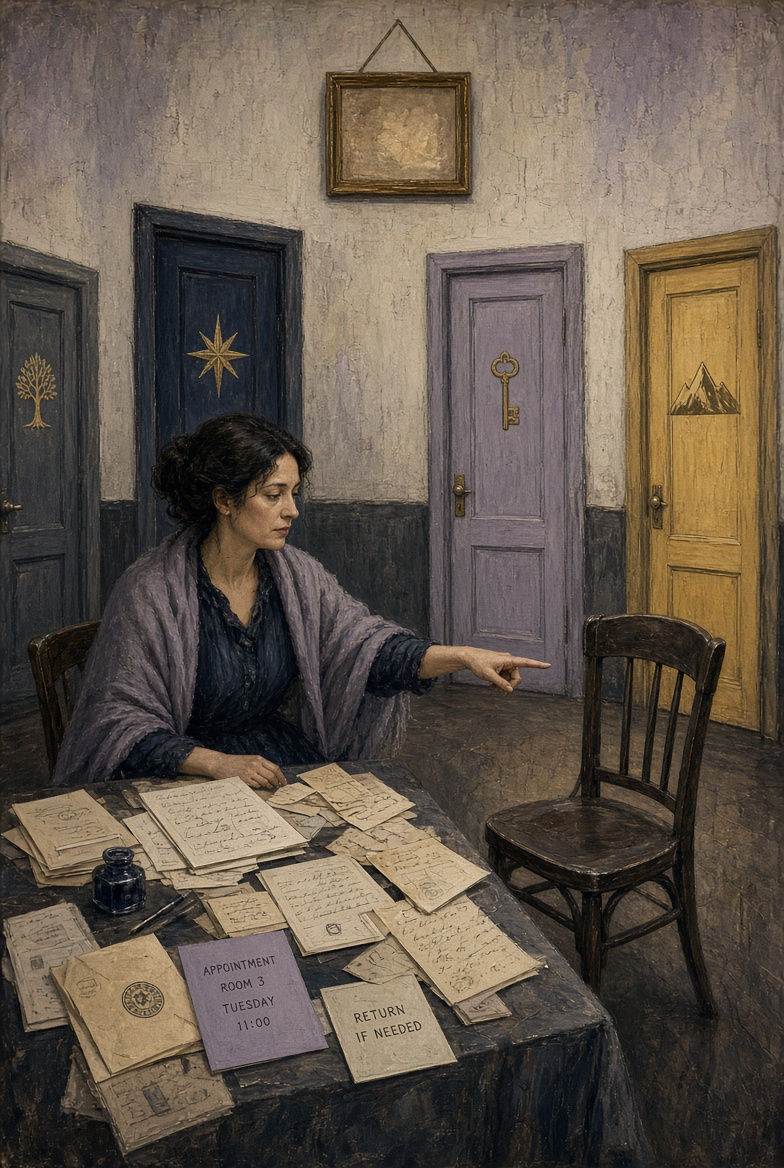
IV.
She asked for things. This matters, because it is where the story stops being only about neglect and becomes something closer to a duet nobody finished.
She asked for written information, because she needed time alone with a sentence before she could agree to what it asked of her.
She asked for appointments to be explained beforehand, so a room would not simply happen to her.
She asked whether someone who understood her background — her Judaism, her family's flight, the particular grammar of a life built twice — might be present, so she would not have to translate herself from nothing each time.
She asked why adult social care was never in the room, when so much of what ailed her was not, in the end, a disease of the mind but a poverty of support.
She asked why every difficulty was filed, by reflex, under illness, as if her exhaustion, her isolation, her grief for a home that no longer existed even in memory, could only ever be symptoms and never facts.
Some requests were written down. Some were passed along and along until they arrived nowhere. Some simply stopped, the way a letter stops when nobody is at the address any more.
Everyone involved was working. Everyone was, by the measure of their own brief, helping. And still an enormous quantity of competent help could be assembled around a single woman and fail to add up to her being helped.

V.
There is a further thing I must tell you about Miriam, because it is the part institutions found hardest to file, and the part I recognised fastest.
She was never only one thing.
She was a Jew whose family had fled a Muslim-majority country, which made her relationship to safety and belonging more complicated than either word could carry alone. She was a mother, which is its own country, with its own unwritten law. She was a patient, a category that swallows whichever of the others is inconvenient to a waiting room. She was, at times, a woman whose mind worked in a manner the forms had no space for — which made her, on paper, a set of symptoms, and made her, to anyone who actually sat with her, someone thinking extraordinarily hard about an extraordinarily difficult life.
No single service was built to hold all of that at once. Each took the piece it recognised and set the rest gently aside, the way you set aside a coat that is not yours, meaning to find its owner later.
Her silence, especially, was often misread. It was recorded, more than once, as though it settled a question rather than raised one. But silence rarely means what the listener hopes. Sometimes it means I am overwhelmed. Sometimes it means I do not have the words in the order you require them. And sometimes — nobody wrote this one down — it means I have already said this, to more than one of you, and nothing changed.
A person can be surrounded, attended to, assessed, referred, and still not be seen. I do not think that needs proving. Anyone who has stood in a crowded room feeling entirely alone already knows it.

VI.
As the years passed, a word began appearing beside her name so often that it stopped being a finding and became scenery.
She has capacity.
She has capacity.
She has capacity.
And because she had capacity, the collective attention around her relaxed, as though capacity were a form of safety rather than merely a form of law.
But capacity is not wellbeing. Capacity is not safety. Capacity is not the absence of need, and it is not agency — agency being a larger, more fragile thing: not merely the ability to answer a question correctly, but the ongoing, supported possibility of shaping one's own life.
A person can have capacity and still be profoundly vulnerable. A person can be vulnerable and still possess agency. These are not contradictions. I would say they are the entire difficulty of caring for another human being, compressed into two sentences most systems are built to treat as mutually exclusive, because a system prefers not to hold two true things at once.

VII.
I should tell you about the hesitation too, because it was not born of indifference. It was born of an excess of conscience.
Nobody wanted to pathologise a Jewish mother's grief. Nobody wanted to mistake the language of faith for the language of illness. Nobody wanted to treat a refugee's watchfulness as paranoia. Nobody wanted to remove children from a mother who loved them. Nobody wanted to override the choices of a competent adult.
Each hesitation was, on its own terms, a form of respect. Together they built something else: a system that would only act once the situation had become undeniable — which is to say, once it had become a crisis. Prevention remained a value everyone professed and nobody quite carried out, because prevention asks you to act on a trajectory, and a trajectory does not announce itself with a file number.
Somewhere in that long, well-meaning hesitation sat a question nobody said aloud: at what point does watching someone decline become, itself, a decision?
VIII.
There is a part of what happened to Miriam that I will not set down here, and I would rather tell you that plainly than pretend the silence is an accident.
A single story cannot hold everything that happens inside a family. And some griefs are not mine to spend on her behalf, or on theirs, without a permission I no longer have any way of asking for.
I will say only this. She had four children. She loved them without qualification, which is not the same as loving them without pain. Something happened, in the fullness of time, between two of her daughters and her eldest son — her firstborn, the first branch of everything her own parents had carried out of exile and planted again in a country that was not, at the start, theirs. I will not describe what it was. I do not think Miriam would have wanted it written down as an event with a shape, to be read by strangers and closed like a file. I think she would only have wanted it known that it happened, and that she could not stop it, and that in the end she could not keep watching it continue.
A lineage had survived expulsion, and a yellow badge, and a departure by night, and a second departure by day, and had crossed water more than once carrying only what could fit in a small suitcase. It did not survive a kitchen table.
I do not know all of it. What I carry is not the event but its aftermath — a held breath that never fully released, a silence at a table that had once been loud, a woman who stopped asking institutions for help not because she no longer needed it, but because the harm she could no longer bear to witness was not the kind any of the services she had spent her life petitioning had ever had a form for.

IX.
By then her illness had already given her a reason to leave. What happened at that table gave her the will to actually go.
England, at that time, did not permit what she needed. The door she was asking for did not exist yet in the country that had, once, been the safest place her own parents ever found. She could not ask an English doctor the question she needed answered, because English law had not yet decided that anyone was allowed to ask it.
So she went to France first — to Paris, where she had been born, where the flat that smelled of Algeria had once stood, where a nineteen-year-old girl had first heard a boy describe a valley the colour of lavender — though she never explained to me why she needed that stop before the next one, and I never demanded she should — and then on to Switzerland, where a different door existed, tended by people who did not know her. They had never met her GP, or her psychiatrist, or her social worker, or her advocate. They knew nothing of the yellow door, or the six filing cabinets, or the son she could no longer watch being lost to her. They knew only what the forms in front of them told them: a woman, terminally ill, of sound mind, requesting to die.
They were not wrong, by the measure they had been given. They were, like everyone before them, working from a fragment.

X.
A doctor there asked her, gently, why.
"I am tired," she said. "Tired of the illness. And tired of watching."
"Watching what?"
She did not answer that part. I do not think it was evasion. I think some things a mother should not have to explain twice, and she had already, in her own way, explained it once, to people who were not in that room and never would be.
"I am not asking you to stop me," she said instead. "I am only asking you to be sure that what you are calling my choice was not, in the end, abandonment wearing a kinder word."
The doctor did not have an answer for that either. Nobody ever quite did.

XI.
I told you her eldest son had been lost to her. I did not tell you the whole of it, because I do not have the whole of it to give, but I will tell you this much now, because she would have wanted it told even more than she would have wanted the rest of it kept quiet.
Years before, when he was still a boy who thought promises were simple things, he had told her that she would not die alone, and that she would not die in pain. Children make promises like that without knowing what they will cost. Most are never called in.
By the time hers was, he had already been put outside the family's inner circle, and outside the circle of the community that had raised them both. I will not tell you why. I do not fully know why myself, and what I do know is not mine to spend. He did not know the whole of it either — not what had happened at that table, not the choices that were made around it, not the shape of the thing that had cost him his place among his own people.
He came anyway.
I think this is the part of the story that matters most, though it is the smallest part, and the part with the least explanation attached to it. A man who had been put outside everything that was supposed to hold him, who did not have the facts other people had, who had every reason available to him not to come, came — because he had once said a sentence to his mother and had never, even in exile from his own family, considered that a sentence like that comes with an exit clause.
He sat with her in Switzerland. He made certain the pain was managed properly, by people who did their work well because he made certain of it. Whatever else was unresolved, whatever else had been lost at that table and never recovered, one promise, made years earlier by a child who could not have known what it would ask of him, was kept in full.

XII.
Someone, much later, opened her file — not a doctor this time, only whoever is left to close such things when a person dies abroad. There were hundreds of pages, and no single account of Miriam anywhere among them.
Fragments. Mental-health assessments. Maternity records. Correspondence from social care. Safeguarding notes. Letters from her advocate. Medication charts. A worried, unanswered note from a family member, dated years before the end. Requests for adjustments that would have cost very little and were never made. Notes on her religion, her flight, her culture, filed as background rather than as the ground she stood on.
Nowhere in any of it was there a note about a kitchen table, or two daughters, or a firstborn son who had once been the first branch of everything, or the promise he kept after everyone had decided he no longer belonged. That part of her had never been anyone's to file. It had only ever been hers to carry — and, at the very end, his.
Each document, alone, made perfect sense. Together, for the first time, they made a woman — one whose vulnerability had been noticed, over and over, by people who were never quite in the same room as each other, and who were never in the room at all for the thing that actually finished the work, or for the one person who showed up anyway.
England never got to ask her whether enough had been done. She had already left by the time the question might have mattered, and the law she needed to ask it properly did not yet exist to ask it with.

XIII.
She held something in her other hand at the end. A sprig of lavender, dried, from a garden that was not that garden, in a country that was not that country — the England she had been given as a child, the England of the yellow door, the England that, in the end, could not let her leave from inside it.
Her son held the hand that was not holding the lavender.
I do not think she was angry at England. I think she loved it the way you can only love a promise that was mostly kept — and I think, in that last hour, she came to understand that a promise can be mostly kept by a country and entirely kept by a son, in the very same lifetime, and that both of those things can be true at once, the way capacity and vulnerability can, the way surrounded and unseen can.
Her hand closed around the lavender as her breath went. Her other hand did not need to close around anything. It was already held.

XIV.
I have carried a great deal in this telling, and set down only a fraction of it, because a single story cannot hold a lineage, and because some of what I carry was never mine to spend.
I say this not to excuse the silence but to name what it is standing in for. The omission that took Miriam from her own country was larger than any single person could have been asked to hold. Larger than her son, who held what he could and very nearly did not survive holding it. Larger than the doctors, who each held only the fragment placed in front of them. Larger, even, than Miriam herself, who held all of it for far too long, alone, before she stopped being able to.
Someone has to hold what is left over once everyone else has done what they could and gone home. I have come to think that is the whole of my vocation, if a stuffed panda may be permitted one. Not to fix what was omitted — that is beyond me, and was beyond everyone who tried. Only to carry the part of it that would otherwise fall on nobody at all, so that it is not entirely lost, and so that someone, someday, might be able to set it down properly instead of merely surviving it. If that makes me a kind of warrior, it is a strange and sedentary sort — fought sitting on a shelf, in the dark, for centuries at a time, holding a story until somebody is finally ready to hear it.
We have grown used to the phrase death with dignity, and there is nothing wrong with wanting it. But we have, perhaps, placed the emphasis too late in the sentence of a life. There is dignity in life to think about too — dignity in childbirth, in mental illness, in exile, in faith, in the plain exhausting act of asking a system to see you as more than the department it has assigned you to. Dignity in a family staying whole. Dignity in a promise kept by someone who had every reason to walk away from it. Dignity in being believed the first time, so nobody has to spend thirty years proving the same sentence true, and then leave the country to finish the sentence somewhere else.
Perhaps the largest safeguard anyone can build for another person is not a further form, or a further panel, but someone willing to ask what has happened to this person before asking what does this person want — and then to ask, honestly, whether everything that could reasonably have been done, was. Nobody asked Miriam that in time. Not because they did not care. Because the door that question needed did not exist yet, in the only country she had ever called safe.
Miriam kept the yellow door until the end, even from a distance. She never repainted it.
"A door is not a refuge simply because it is painted yellow," she used to say.
Then she would open it, and invite whoever was standing there inside.
I recognised the colour before I understood why it moved me. It took her whole life, and something older than her life still lodged in me, to understand that she had taken the one thing history had used to mark her out for harm, and repainted it, on her own door, as an invitation — and that in the end, the door stayed in England, and so did I, and she did not, though her son made sure she did not go through the last of it alone.
The door is still there.
I am only a panda, on the outside of it. I cannot open it for you, and I could not open it for her.
But I can tell you it is unlocked, and that it is yellow on purpose, and that the only question left standing is the one Miriam kept asking, in more than one language, in more than one country, long after everyone who might have answered had stopped listening for it — everyone, that is, except the one who came back.


Comments